

A conversation with Alex Heidtke, PE, Engineering Manager
Leading site development in Chicago requires agility, perseverance and a deep love of problem solving. There are multiple agencies with multiple requirements, a dense underground utility network and decades of engineering decisions already in the ground that your project must work around. Alex Heidtke has spent her career navigating exactly that — and over the past five years at Greenprint, she’s become a cornerstone of how we approach civil engineering in the city.
As a licensed professional engineer, Alex has built deep roots in Chicago-area civil and site engineering over her career. While Alex’s work has spanned many sectors, from green schoolyards to affordable housing, parks to higher education and healthcare, her work is driven by a desire to design sites that serve the people who live, work, play, learn and heal at them everyday.
Growing with green schoolyards
Before joining Greenprint, Alex served as project manager and project engineer on half a dozen Space to Grow green schoolyard projects at previous firms. That program — a partnership between the City of Chicago, Department ofWater Management, Department of Environment, MWRD, Chicago Public Schools, Healthy Schools Campaign and Openlands — transforms asphalt-heavy school sites into stormwater-managing, community-serving green spaces. Working within that program means navigating a well-structured review process with multiple city partners, each bringing adistinct perspective.
“You’re coordinating with multiple agencies and organizations — and the school itself,” Alex explains. “Each of those partners brings real expertise and legitimate priorities to the table. The school might want a track. CPS has design standards that keep maintenance manageable across hundreds of sites. The City needs to confirm you’re not conflicting with utilities in the right-of-way. Your job is to understand all of those perspectives and find the design that works for everyone.”
Along the way, she’s developed material knowledge that only comes from doing this work repeatedly. CPS has well-established site standards for good reason — materials need to hold up across hundreds of schools with varying maintenance capacity. Porous asphalt, for instance, works well for pedestrian use but requires careful installation in areas with vehicular traffic. And with resilient rubber surfacing on playgrounds, you need to think about where kids actually move (i.e., the natural paths from equipment to equipment) because those high-wear zones benefit from reinforcement from the start.
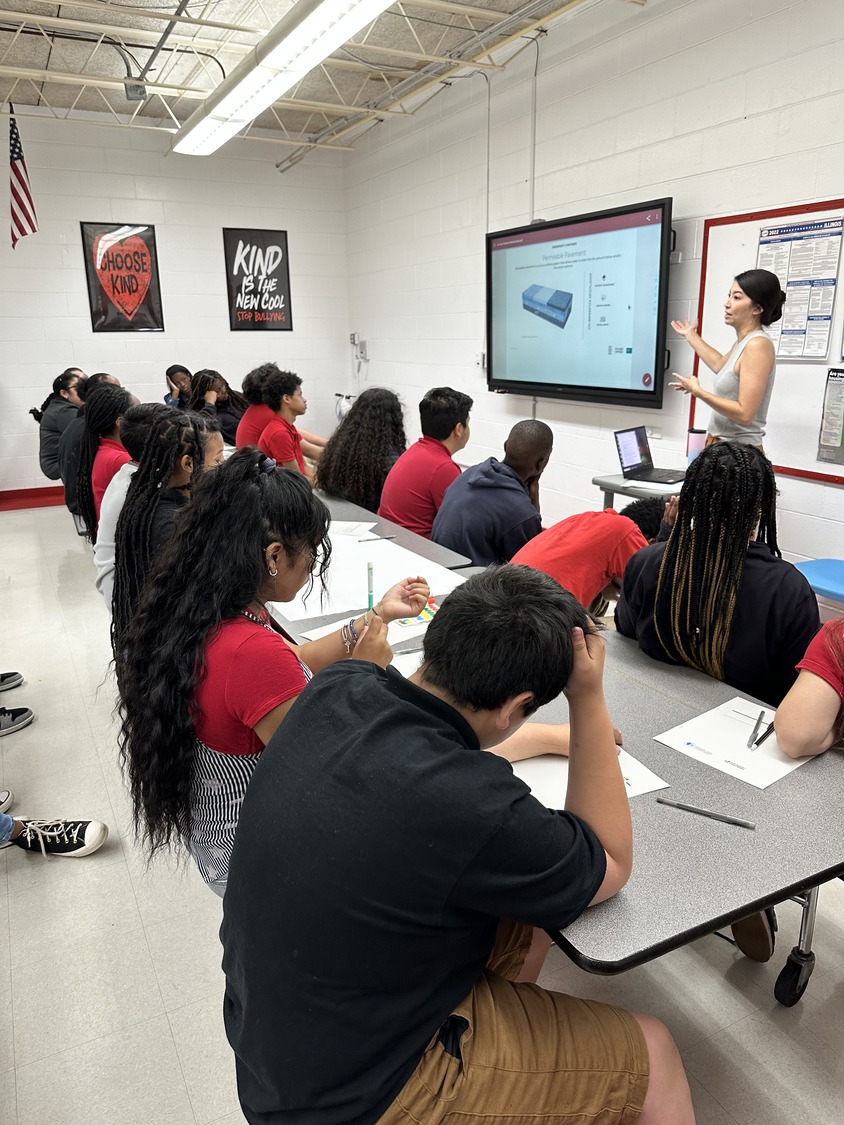
“One of the things I love about green schoolyards is the chance to teach kids about the water cycle at an early age — to make civil engineering visible instead of just something buried underground.”
The advantage of working alongside landscape architects
One of the things Alex points to as a real differentiator at Greenprint is the in-house relationship between the civil engineering and landscape architecture teams.
“If you’re sending files back and forth, you’re going through all these fluctuations instead of just sitting down together and working through it,” she says. “We need to put the stormwater storage in this location — so what does everything above it look like? Where can trees go, where can’t they? Being able to do that in real time moves things along a lot faster.”
That kind of coordination also extends into the design charrette process — engineering isn’t just handed a background and asked to fit utilities around it. They’re at the table from the start, which means fewer surprises and smarter solutions.
Unearthing opportunities that cut costs while expanding benefits
Some of Alex’s best work is the kind that saves clients money they didn’t know they were overspending. A recent example includes an affordable housing development where the initial design called for a full new detention basin, because that’s what appeared to be required under current stormwater regulations.
Alex dug into old permits and discovered that an adjacent parcel already had a detention basin — one that had been sized decades earlier to eventually capture runoff from this site too. Working through the local permitting process, Alex was able to right-size the on-site system to work in concert with the existing basin rather than duplicate its function.
And since the team was already rethinking the stormwater approach, they went a step further: instead of a standard detention basin, they designed a rain garden that uses specialized soils to filter and infiltrate water, stays shallower, and more aesthetically integrates into the site and helped support the project’s pursuit of LEED credits.
The client was “perfectly happy to install a larger detention basin,” Alex says. “They didn’t know they could save money by doing something smaller. That’s the job — finding that.”
City of Chicago expertise, across a diversity of projects
Green schoolyards are one part of what Alex brings to the table. Her Chicago-area project portfolio also includes work for the Chicago Park District, University of Chicago, Illinois Medical District — which means she’s worked through the City’s permitting requirements across a range of project types and client contexts.
She’s worked as a sub-consultant under architects and landscape architects, understands how to function inside large project teams, and knows how to keep civil engineering cost-effective when it’s the first line item that gets value-engineered.
When civil engineering isn’t invisible
Alex is honest about the fact that civil engineering can be a hard sell. It’s underground. It’s not photogenic. Architecture and landscape get all the glory, but civil ensures safety, resilience and functionality that most people take for granted.
But the impact is real. She describes one school Greenprint is currently working with that floods 10 times a year, with four staff on call each time to pump water out before it backs into the building. A well-designed green schoolyard that manages stormwater on-site doesn’t just fix that school’s problem. It takes pressure off the shared sewer system, which can reduce basement backups for neighbors, too.
“It feels like the work matters,” Alex says. “You’re solving a real problem that people are living with. And if you can also teach a kid something about how water moves through the world while you’re at it — that’s the good stuff.”
---
To talk through a project in Chicago — school, housing, healthcare or anything inbetween — reach out at info@greenprintpartners.com.

.jpeg)


